.svg)
Data as of September 8, 2026, unless noted. Onchain figures from DefiLlama and Rialto Analytics. This is independent analysis based on public data and has not been reviewed or endorsed by Robinhood.
Robinhood Chain is just over two months old and currently serves three main purposes: perpetuals, memecoins, and tokenized stocks. Only the third was in the launch announcement. This is a look at what has actually shown up onchain, venue by venue.
What it is: A permissionless Ethereum Layer 2 built on the Arbitrum stack, live since July 1. The flagship product is Stock Tokens: onchain representations of 202 US stocks and ETFs. These are not shares. They are tokenized debt securities issued from Jersey that track prices via Chainlink feeds, with no voting rights and no claim on the underlying equity.
Who can touch it: Stock Tokens are available in 120+ countries, but not to US persons, and not in the UK, Canada, Switzerland, or the UAE. Access runs through Robinhood Wallet, the self-custody app; the main brokerage app does not connect to the chain. The one US touchpoint is Robinhood Earn (below). Permissionless infrastructure, permissioned distribution.
The vision: "Bringing the best of traditional finance and DeFi together," in the words of Johann Kerbrat, Robinhood's SVP of Crypto and International. The launch suite covered 24/7 Stock Tokens, Earn, and perpetuals, with native lending and agentic trading accounts to follow.
Headline metrics, September 8, 2026
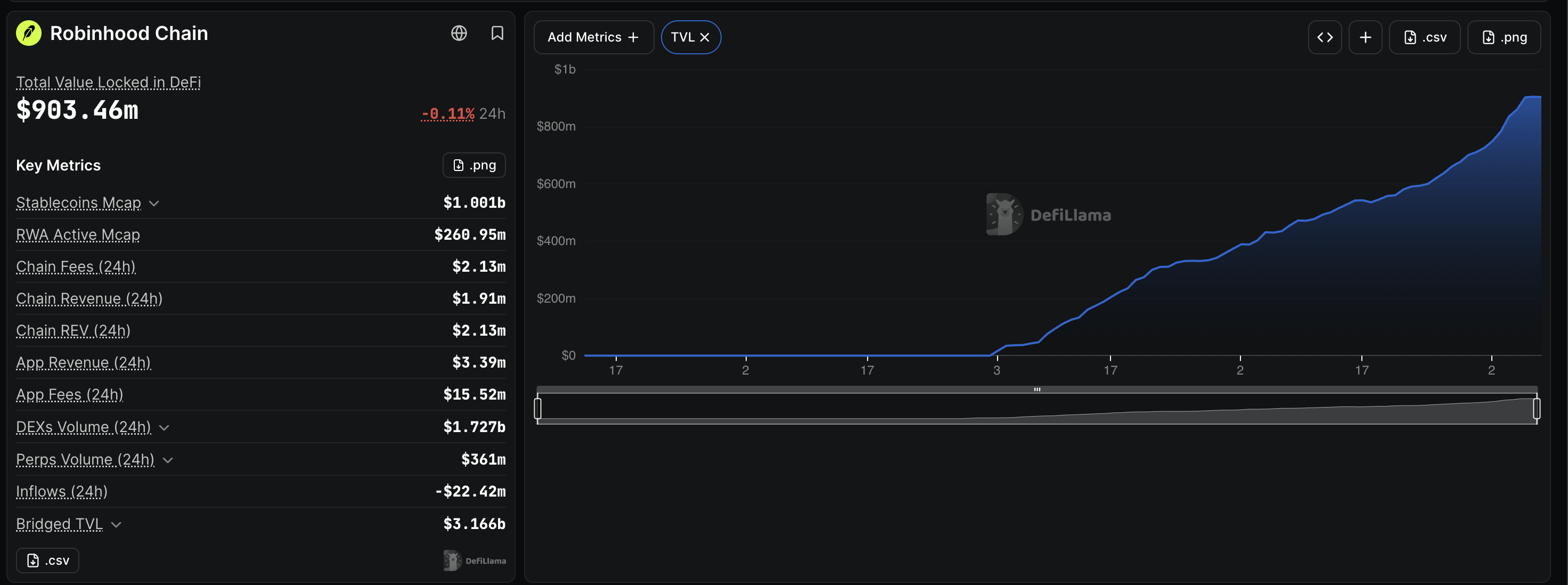
- TVL: roughly $900M in total value locked in DeFi, more than double a month ago; the record was $914M on September 7
- DEX volume: $11.4B over the past week; record $1.89B day on September 4; nearly $44B cumulative since launch
- Perps volume: $230M to $360M a day across the chain's perpetuals venues in early September
- Stablecoins: $1.0B on chain, crossing the billion mark on September 8 after rising 25% in the prior week; USDe accounts for roughly a third
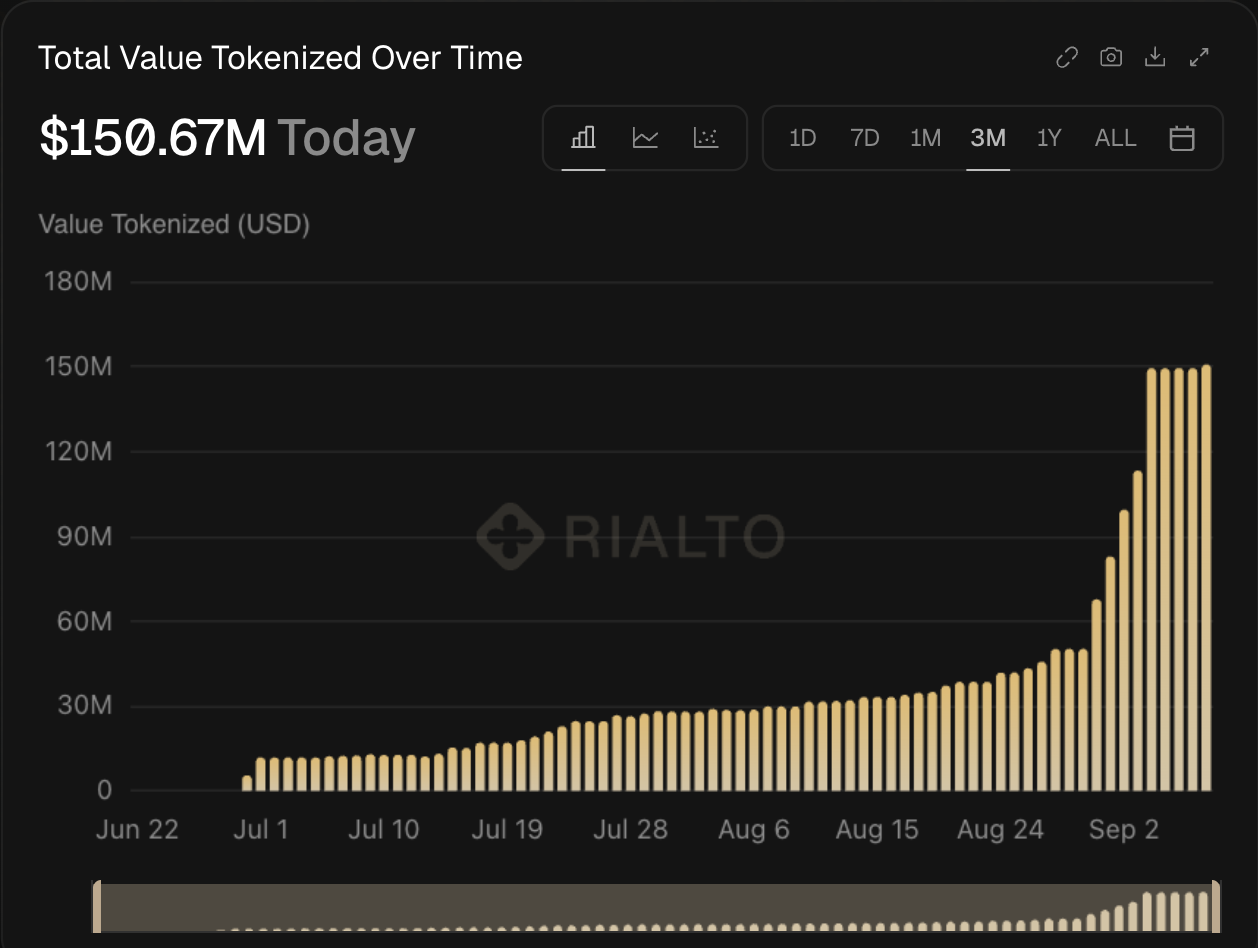
- Tokenized real-world assets (RWAs): $147M in Robinhood-issued tokenized assets across 202 tokens, up from about $13M in mid-July and $96M on September 1 (Rialto Analytics). DefiLlama's broader all-issuer measure reads $261M, up from $198M on September 1.
- Revenue: chain revenue passed Solana, Ethereum, and Tron on September 2 ($4.01M) and peaked at $5.4M on September 4, on $6.0M of fees; by September 8 it was $1.9M, with application-level fees of $15.5M that day. Value is accruing to launchpads and exchanges rather than to the L2 itself. Uniswap is the clearest case: revenue paid to UNI holders reached roughly $500K a day in early September, and Robinhood Chain is estimated to account for more than 60% of it.
- Holders: roughly 190,000 Stock Token holders as of September 8, up from under 30,000 in late July (Arbitrum ecosystem data by Entropy Advisors)
Breakout apps and adoption
Perps
Three venues account for the chain's perpetuals volume.
Lighter: Robinhood Chain's perpetuals partner, on a 50/50 revenue split, and the perps venue embedded in Robinhood Wallet. Quoted in USDG. Since July 20, Stock Tokens (NVDA, GOOG, AAPL) are accepted as margin collateral.
Arcus: Built by the dYdX team with Robinhood Crypto. Zero-fee spot on Stock Tokens, perps in beta. Arcus reports $2B+ cumulative volume, $100M+ average daily, and 85,000 on the perps waitlist.
Meridian: Formerly Ethereal, a day-one launch partner. Its mPerps are designed for 24/7 trading of traditional assets whose underlying markets close, settled in USDe, with launch expected in September. (Kappa Lab curates the strategy for Meridian's MLP liquidity vault; see Earn.)
Spot
Overall DEX volume: Two waves. July's launch frenzy peaked at $880M per day on July 11, then cooled to $250M to $600M for most of August. A second wave began on August 30 and has not let up: every day since has cleared the July peak.
.png)
Tokenized stocks have been a small share of that: Stock Token trading ran at roughly $25M a day for most of August, around 5% of a typical day's total DEX volume. The first spike was $85M on August 25, the day of Nvidia's earnings, 78% of it Stock Tokens. Earnings drop after the closing bell; a venue that trades around the clock caught the positioning flow. In early September Stock Token volume, excluding memecoin pairs, climbed to $100M to $130M a day, still under 10% of the total. Uniswap holds roughly 99% of Stock Token liquidity.
Memecoins took the volume: CASHCAT, launched by outsiders using Robinhood's pre-rebrand logo, was the first breakout, peaking above $100M market cap within two weeks of mainnet. It took off three days after CEO Vlad Tenev posted that the chain "works great for memes too."
PONS: The launchpad behind the second wave: about $307M market cap on September 1, $4B cumulative volume, more than $25M in creator fees, and a majority of launchpad volume on the chain since late July. One variable ahead: Robinhood's 90-day gas waiver expires on September 29.
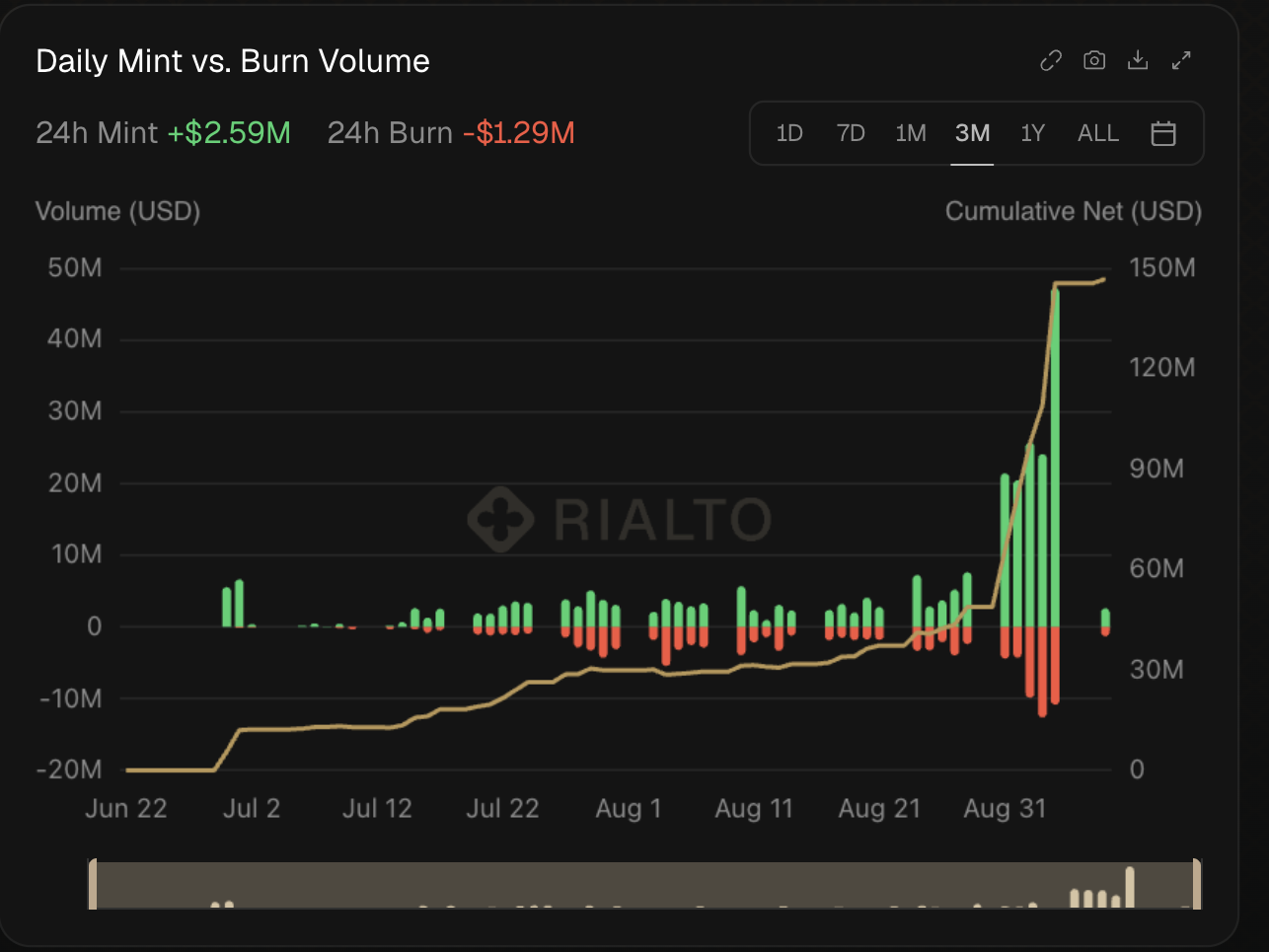
Where the two collide: Memecoins are now quoted against Stock Tokens (Artificial Inu trades against NVDA), and these pairs make up roughly a quarter of stock-linked volume. On the record day, September 1, the pairs traded $217M against $127M for the Stock Tokens themselves. In late August a memecoin paired against tokenized HIMS absorbed 81% of the token's onchain supply into liquidity pools, and the tokenized stock traded well above its underlying share price before arbitrage caught up. Demand is outrunning onchain float; on weekends, with the underlying market closed, nothing anchors the price. Supply responded: issuers minted a net $117M of new tokenized value in the 30 days to September 8. Most of it came in a four-day burst from August 30 to September 3.
Earn
Robinhood Earn: Eligible US users lend USDG from a self-custody wallet inside the main app at an estimated, variable ~7% APY. Deposits flow into Morpho, a lending protocol that lends them out onchain. The yield comes from borrowers, largely market makers funding trading positions. Insurance covers exploits, not principal.
USDe: Ethena deployed natively and reached $320M of USDe on the chain in eight weeks, largely because Earn's vault liquidity is routed into Morpho's USDe/USDG market.
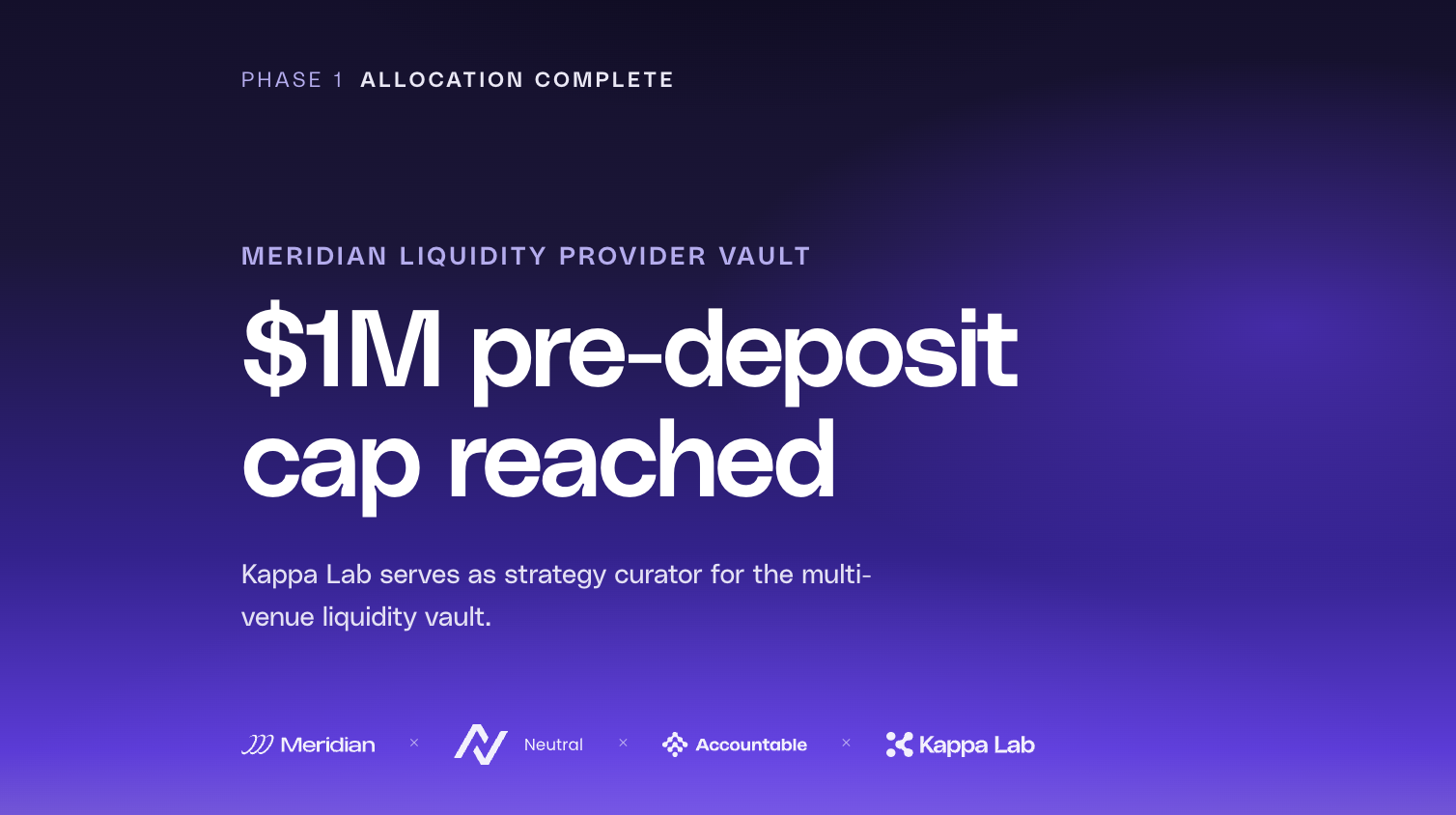
MLP: The Meridian Liquidity Provider vault takes USDe deposits to market-make Meridian's mPerps while hedging on external venues. It filled its $1M cap on August 6, was raised twice to $2.5M, and filled again on August 28. Kappa Lab is the vault's strategy curator, alongside Neutral Trade and Accountable.
Open questions
Four questions are open two months in. The first is liquidity: whether it outlasts the meme phase and the free-gas window that ends September 29. The second is depth: who makes markets in Stock Tokens during the 17.5 hours a day the underlying exchanges are closed, a question the late-August float squeezes put to its first live test. The third is governance: one company runs the sequencer, issues the assets, and controls upgrades, and when block production stopped for about 14 minutes on September 4, Robinhood published no incident notice. The fourth is legal: the companies whose stocks are being tokenized were never asked, and one has now objected. On September 3, AMC's CEO demanded that Robinhood stop trading the AMC Stock Token and threatened legal action; Robinhood declined, citing the Jersey issuer and the exclusion of US persons.
Tokenized equities have been attempted before. What differs is distribution: a brokerage with 28.4 million funded customers operating the settlement layer itself.
At Kappa Lab, we operate liquidity infrastructure at the intersection of execution, risk management, and evolving onchain market structure. If you're building in this space and need reliable liquidity, reach out to schedule a meeting. If you're a foundation looking to generate yield on treasury holdings without giving up custody, that's KLIP. Request a complimentary backtest of your token at klip.kappalab.io.

Your Liquidity?
.svg)
.svg)
.svg)
.svg)
Kappa Lab Capital FZCO is a proprietary trading firm registered in Dubai, UAE. It operates under a No Objection Confirmation (NOC) from the Virtual Asset Regulatory Authority (VARA).
The information on this website is not directed at nor intended for distribution to, or use by, any person resident in any country or jurisdiction where such distribution or use would be contrary to local law or regulation. The content on this website is for informational purposes only and should not be considered an offer or solicitation to engage in any financial activity.