
By Victoria Kabalan · Published November 9, 2026
Data as of November 8, 2026, unless noted. Spread data from pamm.wtf by Titan.
Prop AMMs have traded more than $10B on Ethereum since May 13, on a chain where blocks take 12 seconds and every price update costs gas. On paper, Ethereum is the wrong chain for this design. Here is how it works and why it's succeeding.
What is a prop AMM?
A prop AMM (proprietary automated market maker, often written propAMM) is a trading pool operated by a market maker. A standard AMM prices trades with a fixed formula. A prop AMM lets the maker update the price from its own model/oracle. Traders still swap on-chain against a smart contract, but the price behind it is actively managed.
Prop AMMs grew up on Solana, and it is still their biggest market. In the year to August 2026, they traded about $1.12B of SOL/USDC a day there on average, nearly four times the volume of standard AMMs in the same pair, according to Category Labs. Ethereum came later. Titan's tracked trading history starts on May 13, 2026, and by early October prop AMMs handled roughly 5–10% of Ethereum swap volume.
Why prop AMMs work on Solana
A passive AMM like Uniswap only moves its price when someone trades. When ETH moves on Binance, the pool is briefly out of date. Arbitrageurs trade against the old price, and liquidity providers absorb the loss. This is called LVR, or loss-versus-rebalancing (see this explanation). Pools charge fees partly to cover it.
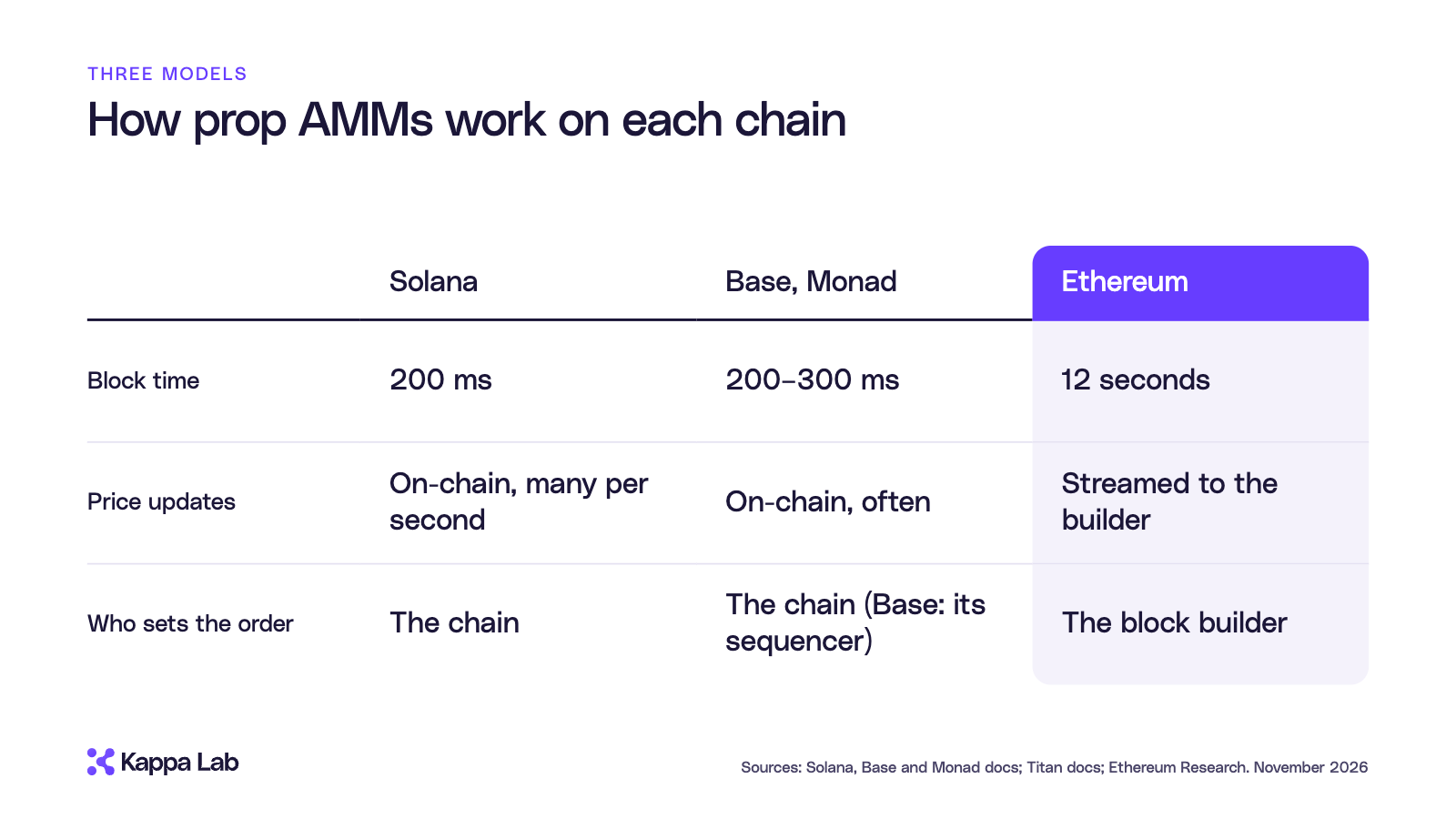
A prop AMM closes that gap by updating its price constantly. On Solana, that is cheap. HumidiFi, one of the largest, sent about 6 million price updates a day as of January 2026, roughly 70 a second. Solana orders transactions partly by fee. So a small, well-paid update usually lands before any trade that could exploit a stale price.
Why that model breaks on Ethereum
- Blocks are slow: Ethereum has 12-second slots, compared with 200 ms on Solana. A price that sits stale for 12 seconds is a much larger risk.
- Updates are expensive: Every transaction pays a base fee, so streaming updates the Solana way would cost more than it earns.
- Builders control the order: Block builders, who assemble each Ethereum block, are paid to maximize its profit. A builder could leave out a maker's update and sell the chance to trade against the old price.
Faster EVM chains such as Base and Monad avoid most of this. Makers there post updates directly on-chain. Ethereum mainnet needed a different answer.
The innovation: the update moves into the block builder
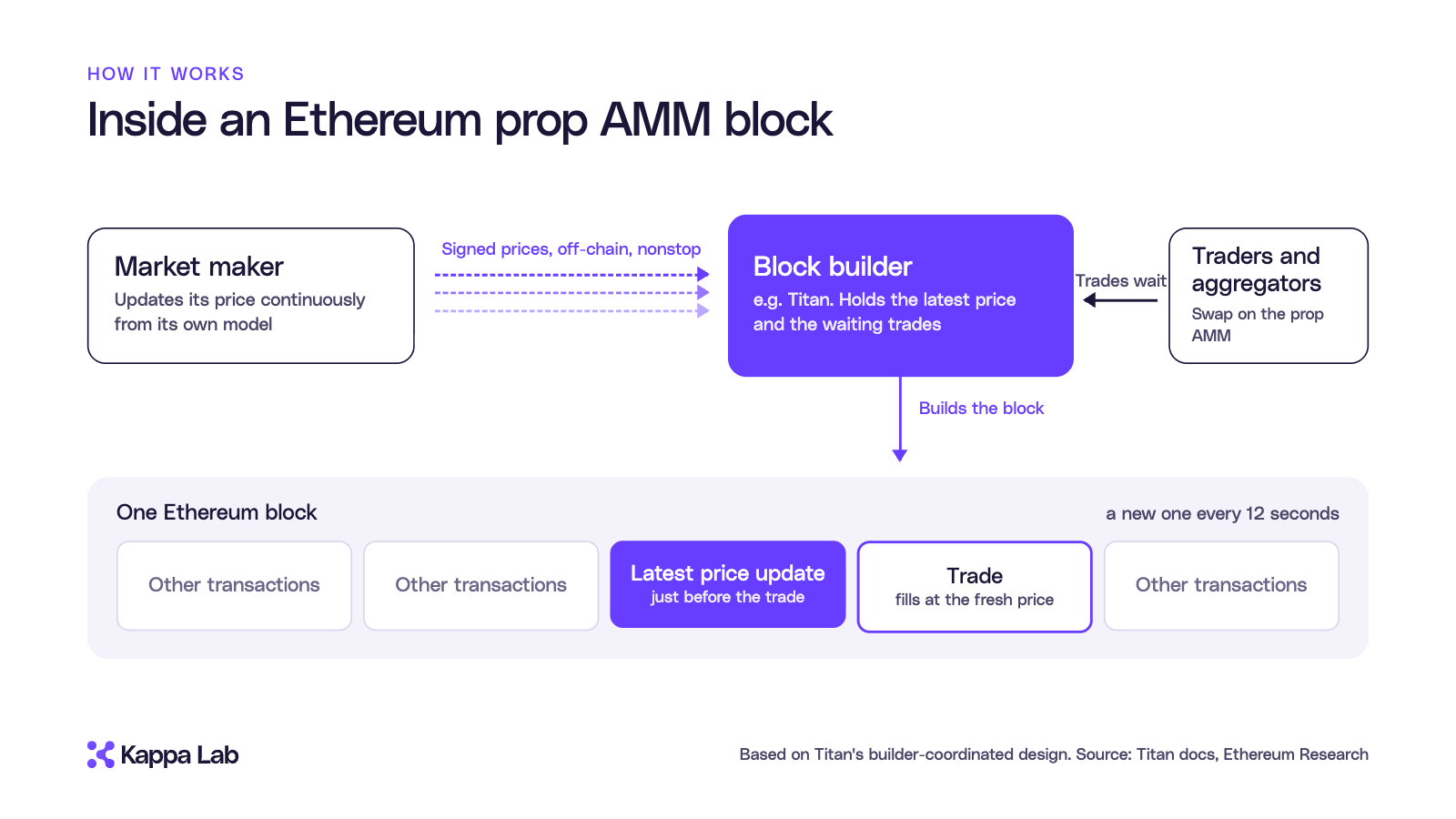
Ethereum prop AMMs don't race to post price updates. They hand them to the block builder. Titan offers the following builder-coordinated design:
- The maker streams signed price updates to the builder, off-chain, throughout the 12-second slot.
- Trades routed to that prop AMM wait with the builder.
- The builder inserts the maker's latest applicable update before the first trade against that venue in each block.
- With conditional inclusion enabled, the builder includes an update only when a trade uses it, avoiding unnecessary update gas.
Titan's configurable freshness protection can require a trade to wait for a sufficiently recent maker update before it is eligible for inclusion.
The maker quotes continuously but pays for at most one price update per prop AMM per block, and only when a trade uses it, as Mike Neuder and Maryam Bahrani describe in their Ethereum Research post on Titan's design. A 12-second block behaves like a live price stream.
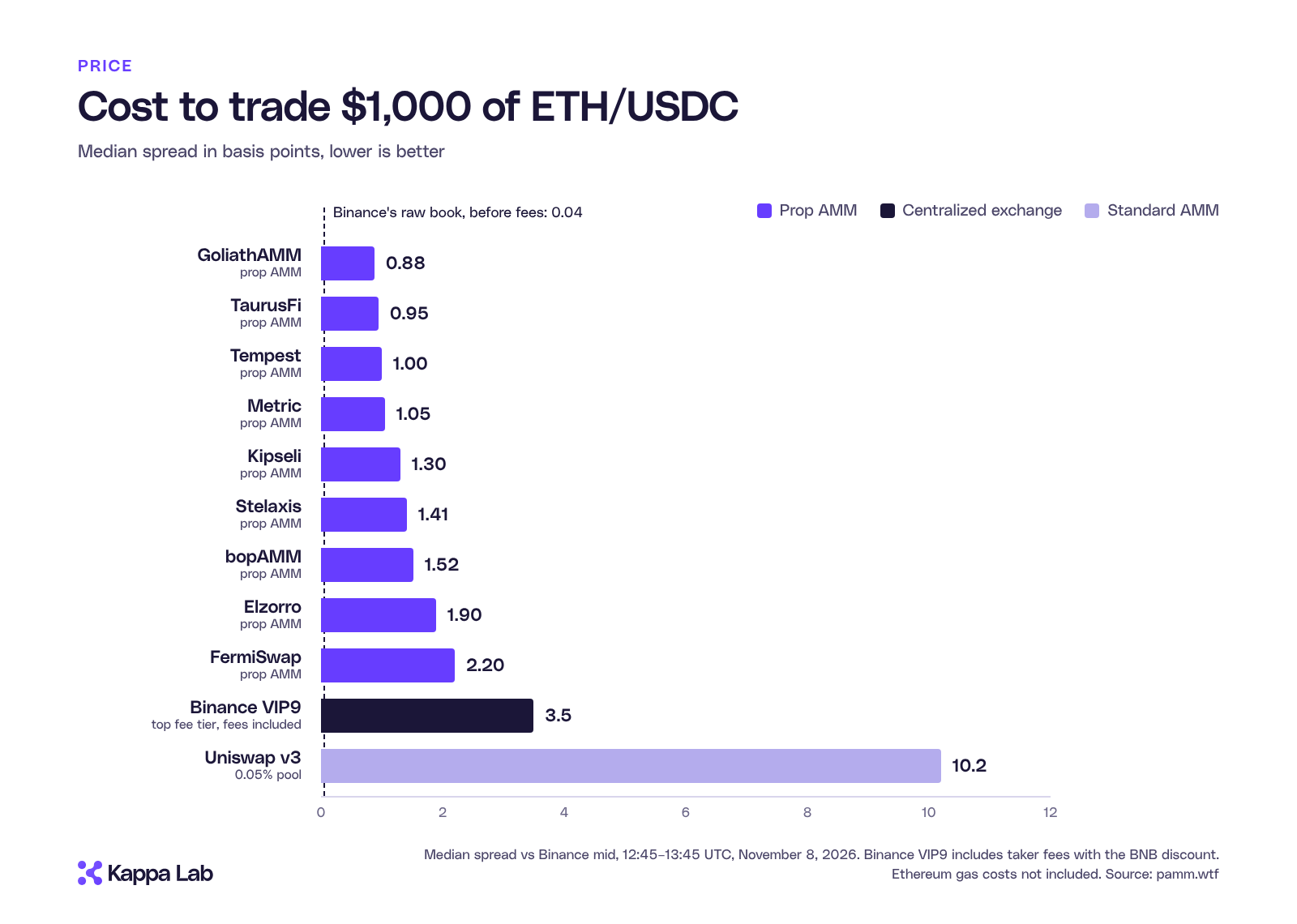
Bebop's bopAMM goes a step further. In private beta since April 2026, the Block Oracle Priced AMM aggregates firm quotes from competing makers into a shared benchmark price that it publishes to builders. Bebop's stated goal is for makers to share the cost of frequent updates instead of each carrying it alone. bopAMM is only quoted at the $1k trade size on pamm.wtf, where its median spread was 1.52 bps on November 8.
How the three models compare
Why they are gaining share
1. Price
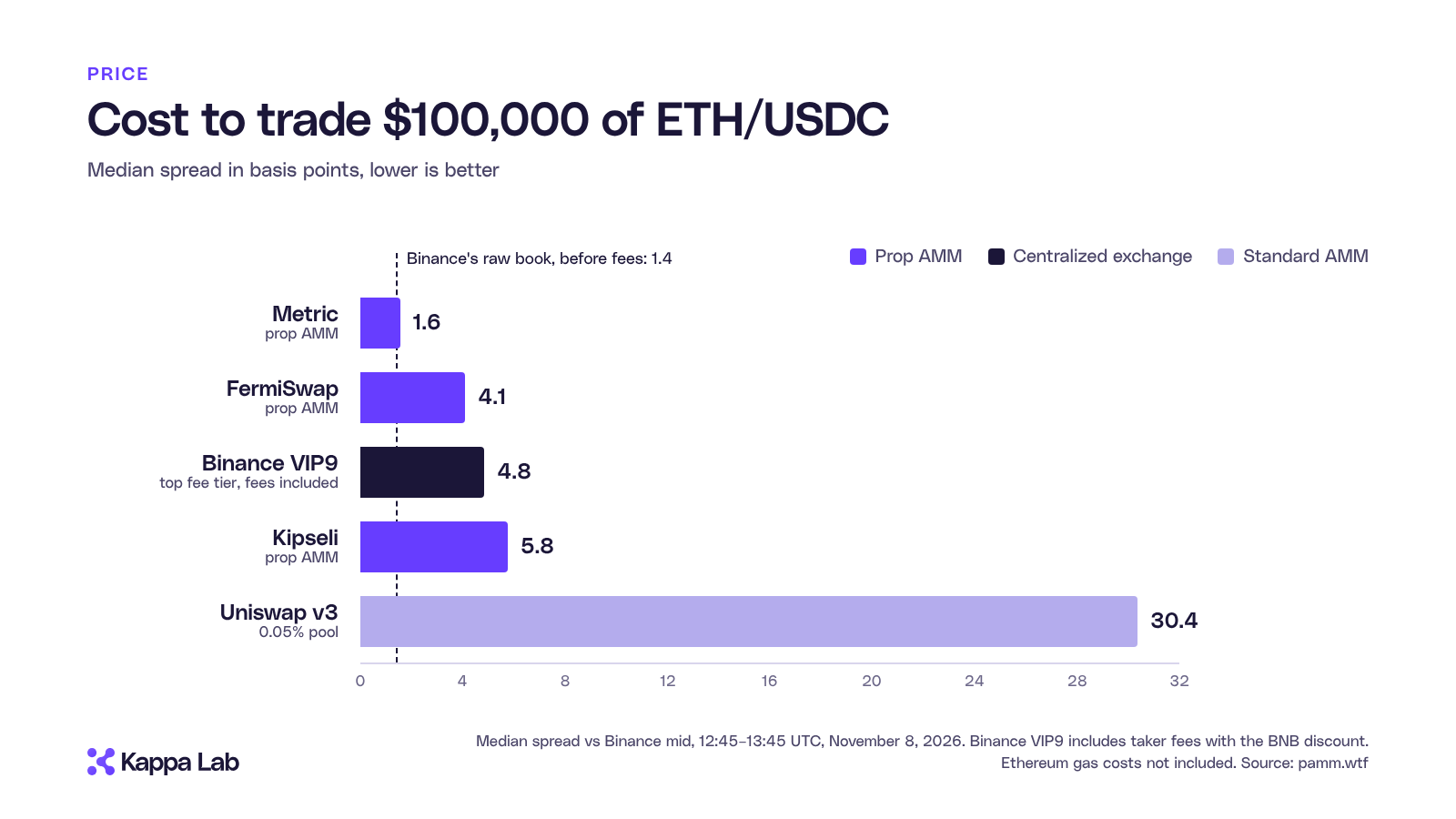
A maker that is not losing money to arbitrageurs can quote tighter spreads. In our November 8 snapshot (1-hour median window, 12:45–13:45 UTC), Titan's public dashboard, pamm.wtf, showed all nine prop AMMs quoting a $1,000 ETH/USDC trade at bid–ask spreads of about 0.9 to 2.2 basis points. Binance, at VIP9 with the BNB balance discount and fees included, came to 3.5. Uniswap's 0.05% pool was at 10.2.
In that snapshot, three prop AMMs returned two-sided quotes at $100,000. Metric and FermiSwap came in at 1.6 and 4.1 basis points, against 4.8 on Binance and 30.4 on Uniswap; Kipseli was at 5.8. Metric and FermiSwap both quoted inside Binance's VIP9 tier with the BNB balance discount at this size. Before fees, Binance's own book was tighter, at 1.4; those two come out ahead once a Binance taker's fee is counted. These are snapshots, they move daily, and they don't include Ethereum gas costs.
2. Distribution
Titan, Quasar and BuilderNet support the mechanism. Aggregators such as CoW Protocol and KyberSwap route trades to these venues, so traders reach them without changing how they trade. PropellerHeads' Fynd router includes prop AMMs by default on its API, and its Tycho toolkit feeds Titan's live prop AMM quotes to other routers and solvers.
3. Easier entry
Three new venues have started trading since mid-September. On October 14, LambdaClass released PropAMM Factory, open-source software that bundles the pool contract with the code that streams prices to builders.
The prop AMM landscape today
Solana: where it started, still the largest
- Prop AMMs handled 40% of Solana spot DEX volume in Q3 2026, down from 51% in Q2, as memecoin trading moved back to standard pools (Blockworks)
- Prop AMMs focus on major pairs such as SOL/USDC, so their share rises and falls with the asset mix
- Leadership shifts fast: BisonFi overtook HumidiFi as weekly volume leader in mid-January 2026 and handled about 13% of all Solana spot volume in Q3 2026
- Other active venues: HumidiFi, Tessera V, GoonFi, Scorch, ZeroFi, AlphaQ, SolFi
Base: where it is spreading next
- First prop AMMs went live on October 30, 2025, with Tessera the largest (Solmaz, Heimbach and Milionis)
- Daily ETH/USDC volume grew from $9.5M in their first three months to $29.6M by June–August 2026, and their share against AMMs from 2.4% to 10.9%
- Blocks are fast and updates cheap, so makers post prices directly on-chain, as on Solana
- Active venues: Metric, Tessera V, ElfomoFi, Kipseli, BaiBai, LunarBase
- Some makers run across chains: DefiLlama tracks Metric across multiple chains, including Ethereum and Base, and Tessera V on four
Monad: the latest fast chain
- First prop AMM launched in early April 2026, about four months after mainnet launch on November 24, 2025
- Daily MON/USDC volume on prop AMMs grew from $2.1M to $3.9M, and their share against AMMs from 12.5% to 45.7%, a much faster climb than on Base (Category Labs)
- Blocks land about every 300 ms, so makers post prices directly on-chain, as on Base and Solana
Ethereum: the newest, and concentrated
- About $10.08B traded since May 13 (including the current partial day), with FermiSwap at 59.1% and Metric at 33.0% (Titan dashboard, November 8)
- Latest full week, November 1–7 UTC: about $1.48B, up 59% on the week before
- Active venues: FermiSwap, Metric, Kipseli, Tempest, GoliathAMM, Elzorro, Stelaxis, TaurusFi, with bopAMM in private beta
Active venues = venues with trading volume in the seven days checked on November 8.
Kappa Lab provides on-chain liquidity on Base and Solana via prop AMMs. If you're a token issuer and looking to improve on-chain liquidity, reach out.
What remains open
- Builder dependence: Blocks from builders that don't support the mechanism usually carry no fresh prop AMM quotes, which can worsen execution. So the price a trader gets can vary from block to block. Integrated builders such as Titan guarantee the update lands before the trade, but nothing guarantees it outside them. Wider ordering guarantees, or blocks built by several parties, could reduce this dependence.
- Volume quality: A September 1 data memo found that about a quarter of late-August volume was round trips (buying and selling back the same amount). The share swings week to week (it was 3% of FermiSwap's volume a week earlier and 34% that week), so headline totals, including the ones above, can overstate real trading demand.
- Shared infrastructure: In September, Flashbots fixed a bug in its shared Priority Update Registry, which some venues use to publish prices. It could have let an attacker publish prices for any venue on it. Flashbots found no evidence of exploitation before remediation, while noting that its review could not prove absence.
Kappa Lab View
On Solana, running a prop AMM is a race for speed and fee priority. On Ethereum, it is a coordination job: makers need builder integrations, steady update streams and a view of which blocks carry their quotes. The payoff already shows in the spreads. In our November 8 snapshot, the two largest venues quoted inside Binance's top fee tier on a $100,000 trade. The cost is a new dependency. For anyone routing size on Ethereum, the question is no longer only which pool is deepest. It is also which block the trade lands in.
Frequently asked questions
1- What is a prop AMM in crypto?
A prop AMM (proprietary automated market maker) is an on-chain trading pool whose price is typically set by a market maker's proprietary model rather than a fixed formula. The maker updates the price frequently, so traders swap against current market prices while settlement stays fully on-chain.
2- How are Ethereum prop AMMs different from Solana prop AMMs?
Solana prop AMMs post price updates on-chain many times per second and rely on fee priority to land them first. Ethereum's 12-second slots and per-transaction fees make that impractical, so makers stream updates to block builders, who insert the latest applicable update before the first trade against that venue in each block. This design uses at most one price update per prop AMM per block; with conditional inclusion enabled, an update is included only when a trade uses it.
3- Which prop AMMs operate on Ethereum?
As of November 2026, active venues include FermiSwap, Metric, Kipseli, Tempest, GoliathAMM, Elzorro, Stelaxis and TaurusFi. Bebop's bopAMM (Block Oracle Priced AMM) has been in private beta since April 2026. FermiSwap and Metric account for about 92% of the approximately $10.08B in all-time volume tracked by Titan's dashboard since May 13, as of November 8, including the current partial day.


Your Liquidity?


