

By Victoria Kabalan · Published November 20, 2026
Data as of November 18, 2026, unless noted. Venue figures cover the 30 days to November 14 (DefiLlama). Prop AMM and tokenized stock figures are for October 2026 (Blockworks).
On Solana, market makers now price most trading between SOL and stablecoins like USDT and USDC. Tokenized stocks should be next. Instead, passive pools like Raydium take 78% of that flow, even though stock prices are set on Wall Street. Here is how Solana's liquidity is splitting up, and why.
Solana handled $197B of spot DEX volume in Q3 2026, more than any other chain (Blockworks). By October, prop AMMs handled about a third of it, and on-chain order books almost 10%, up from under 1% a year earlier. Most traders never pick a venue. Aggregators (often called routers) handled 55% of Q3 volume, splitting each swap across whichever venues quote best at that moment. So venues compete for the router, and the router rewards price.

How Solana's spot DEX volume splits by venue
Passive AMMs and DLMMs: Raydium, Orca, Meteora, Pump
A passive AMM prices trades with a fixed formula, and anyone can create a pool. That makes it the default home for new tokens. Together, these pools still carry close to half of Solana DEX volume, in three main designs:
- Constant-product pools, like Pump's AMM and Raydium's standard pools, spread liquidity across every price. They rose from 10% to 18% of spot volume in Q3 as memecoin trading picked up.
- Concentrated-liquidity pools (CLMMs), like Orca's Whirlpools, Raydium's CLMM and the v3 pools of Pancake (formerly PancakeSwap), let providers pick a price range, so the same capital goes further.
- Meteora's DLMM splits liquidity into price bins and raises its fee when the market gets volatile.
Over the 30 days to November 14, Pump's AMM did $7.0B, Orca $6.5B, Raydium $4.4B, Meteora's DLMM $3.4B and Pancake $0.5B (DefiLlama).
Their weakness is the one we covered in our Ethereum piece. When the price moves elsewhere, the pool is out of date until an arbitrageur trades against it, and liquidity providers absorb the loss. For a token that only trades on Solana, that cost is small. For SOL, which trades heavily on Binance, it is large. Tools like HawkFi help providers manage their ranges more actively than they could by hand.
Prop AMMs on Solana
That loss on assets like SOL is where prop AMMs took over. A prop AMM is a pool priced by a single market maker's own model, updated many times a second. In October, prop AMMs handled about 64% of Solana's SOL-stablecoin volume, against 27% for passive pools. They are still the largest single design on Solana, but their overall share is sliding as memecoin trading picks up: 51% of spot DEX volume in Q2, 40% in Q3 and 33% in October (Blockworks).
On price, Jump Crypto studied 20 million SOL/USDC fills from March 2026. The median fill landed 0.72 basis points from the best midpoint price across four large centralized exchanges. Jump calls BisonFi "our own", so this is an interested party's analysis.
The market is concentrated. Prop AMMs handled about $23.6B in October. BisonFi took a third of it, and the top four more than two-thirds. One caveat: Tessera, second at $4.0B, has shown no volume on any of its four chains since the week of November 9, and has not said why.

The number of pairs doesn't explain the ranking. Scorch quotes 156 pairs and did $2.3B in October. BisonFi quotes 33 and did $7.9B, most of it in SOL/USDC. Kipseli, which only picked up volume in September, quotes just SOL/USDC and did $0.9B. Nor is October a one-off: BisonFi has out-traded Scorch every month since at least June. Depth in the few pairs that carry the flow matters more.

Jupiter's RFQ (request for quote) system, where market makers quote each trade on demand, works the same way on a smaller scale: about $1.5B, roughly 3% of DEX volume.
Prop AMMs as a service
A market maker no longer needs its own Solana engineering team to quote on-chain:
- Hadron, open to makers since March 2026, gives them a ready-made prop AMM program to configure with their own pricing curve and risk limits. It is built so newer teams, such as those focused on real-world assets or long-tail tokens, can start quoting on-chain, and its pools already cover 550 pairs.
- Flint Trade, introduced in July, handles gas, fees and getting transactions confirmed, and merges several makers' quotes into one virtual order book on-chain. Its perps exchange is in testing on devnet, with a closed alpha planned for the end of 2026.
- Polaris Lab turns a trading desk's existing bids and offers into on-chain liquidity that aggregators like Jupiter can route to.
On-chain order books: Manifest, Deriverse, Archer
Order books offer firm, visible quotes from many makers, and limit orders that rest until filled. They now take almost 10% of Solana DEX volume, while the first generation, OpenBook and Phoenix's spot books, records almost no volume. The newer ones:
- Manifest ($3.2B) is permissionless (anyone can open a market) and charges no protocol trading fees. Its share grew from about 1% in late 2025 to about 7%, after peaking at 8.9% in June.
- Deriverse ($1.1B), a spot order book in beta that trades mainly USDC/USDT, has made up the share Manifest lost since June. So part of the rise is stablecoin flow.
- Archer ($0.2B) went live in private beta in February and opened to everyone in March. It gives each maker its own book, so quote updates don't collide, and its October V2 added resting limit orders and permissionless markets. It lists Backpack Securities stocks brought to Solana through Sunrise.

Tokenized stocks on Solana
Solana DEXs traded $7.1B of tokenized equities in Q3, up 40% on Q2 (Blockworks). Two issuers carry almost all of it: xStocks, and Backpack Securities, which holds the underlying shares and reaches Solana through Sunrise. Backpack overtook xStocks in October with 52% of the month's $4.0B, and took about 70% in the week of November 2.

In theory, stocks suit actively quoted venues. Each token tracks a share priced on a US exchange, where trading thins out after hours, stops at weekends and jumps on earnings. A passive pool is exposed every time it does. A prop AMM or an order book maker can follow the reference price and adjust.
In practice, passive pools carried about 78% of Solana's tokenized stock volume in October, with Raydium alone at 39%. Prop AMMs took about 9% and Manifest about 6% (Blockworks).

The trend points the same way. Prop AMMs took 23% in August, but when volume more than tripled in September, most of the new flow went to Raydium.
One likely reason is timing. Over the last 30 days, 68% of Solana's tokenized stock volume traded outside US market hours, when there is no live price to quote against. That is when a prop AMM is built to widen its quotes or step back. A passive pool keeps quoting from its formula, aggregators send the trade to the best quote available, and the pool's liquidity providers carry the risk of the next open.

Solana perps: pools vs order books
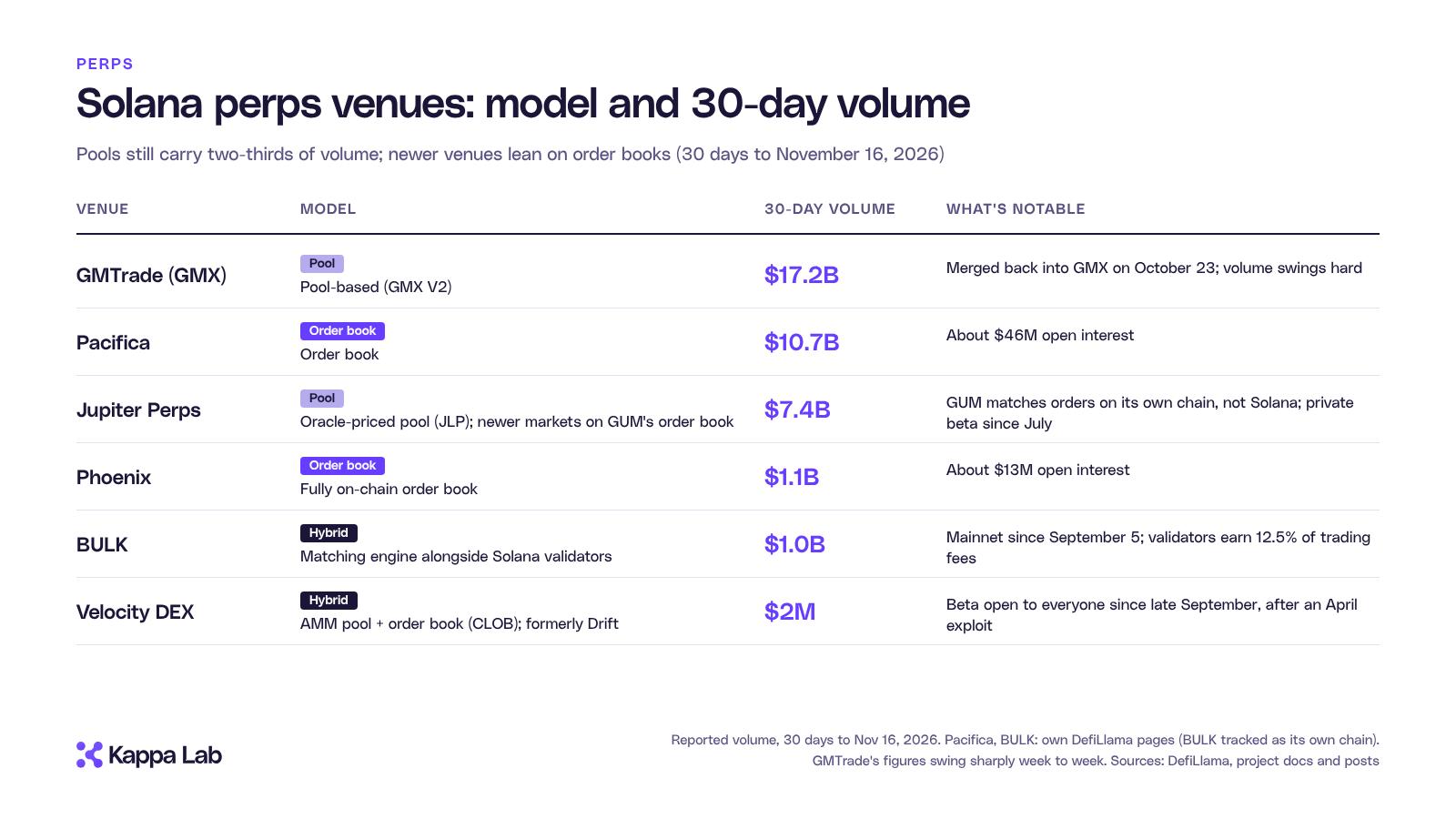
Perps tell a more mixed story. Over the 30 days to November 16, pools still carried about two-thirds of the volume (DefiLlama). Most of it went through GMTrade, GMX's Solana deployment, at $17.2B, and Jupiter at $7.4B. GMTrade's volume is volatile, though: its weekly volume fell 62% in the week to November 16.
Order books hold the other third, led by Pacifica ($10.7B) and Phoenix ($1.1B). And most of the newer venues are built around one: Jupiter's GUM markets, BULK, which runs its matching engine alongside Solana validators, and Velocity, formerly Drift.
What's new after Breakpoint 2026
Breakpoint ended in London on November 17. The announcements that matter most for Solana's liquidity:
- Solana 1.0. Solana dropped its "mainnet beta" label on November 16, after 200ms blocks (October 9) and Alpenglow (October 21) cut the time for a transaction to become final to about 150 milliseconds. Faster blocks give prop AMMs more chances to update their prices.
- Supermassive. Temporal, a contributor to HumidiFi, unveiled Supermassive, a derivatives layer where perps, options and other derivatives will be built on prop AMMs, which reprice inside each trade. HumidiFi is the first market maker, and mainnet is planned for January 2027. It is the spot model this article describes, applied to derivatives.
- Stocks reach more routers. Sunrise's API will bring its tokenized stocks to Jupiter, OKX DEX, Titan, 1inch and 0x, and Jito's JTX terminal now trades xStocks.
- Stocks as collateral. Jupiter and Bullish announced a lending market for Bullish's tokenized $BLSH shares, coming to Jupiter Lend.
- Meteora. The team behind the DLMM launched its Dynamic Liquidity Exchange, and a beta of DLMM Pro, where LP (liquidity provider) funds and on-chain limit orders share the same price levels, so one swap fills both.
- Backpack. The CFTC approved its US derivatives exchange, with one order book shared by US and international traders. It comes from the group whose tokenized stocks now lead Solana's volume.
- Kamino ONE. A swap tool from Kamino that compares 16 aggregators across more than 80 venues, now including CoW Swap. Even the routers compete for the router.
Kappa Lab View
Solana's liquidity is specializing. Passive pools carry the long tail of tokens that only trade on Solana, and so far most tokenized stocks too. Prop AMMs and order books compete for assets with an outside price, where someone has to manage the quote. In spot, actively quoted venues already handle close to half of DEX volume. In perps, order books hold a third, and Supermassive plans to bring prop AMMs next.
As more external assets arrive, more of Solana's volume will be priced against a market somewhere else, and the router will send that flow to whoever quotes it best. That should favor actively quoted liquidity, but only if it competes for stocks the way it already does for SOL/USDC. Tokenized stocks are the test to watch.
At Kappa Lab, we operate liquidity infrastructure at the intersection of execution, risk management, and evolving on-chain market structure. On Solana, we provide liquidity through prop AMMs. If you're building on Solana and need reliable liquidity, reach out to schedule a meeting.
Frequently asked questions
1- What is a prop AMM on Solana?
A prop AMM (proprietary automated market maker) is an on-chain pool whose price is set by a single market maker's own model rather than a fixed formula, and updated many times a second. Prop AMMs handled 40% of Solana's spot DEX volume in Q3 2026 and about a third in October, and BisonFi has been the largest every month since at least June (Blockworks).
2- How much of Solana's DEX volume do prop AMMs handle?
About a third of Solana spot DEX volume in October 2026 (33%, Blockworks), and about 64% of SOL-stablecoin volume in October 2026 (Blockworks). Passive pools such as Pump's AMM, Orca, Raydium and Meteora still carry close to half of all volume.
3- Why do tokenized stocks on Solana trade mostly on passive pools?
In October 2026, passive pools carried about 78% of Solana's tokenized stock DEX volume and prop AMMs about 9% (Blockworks). The most likely reason is timing: 68% of that volume trades outside US market hours, when there is no live reference price. Prop AMMs widen their quotes or step back then, while passive pools keep quoting, and aggregators route each trade to the best available quote.
4- Does quoting more pairs give a prop AMM more volume?
Not on Solana's data. In October 2026, Scorch quoted 156 pairs and did $2.3B, while BisonFi quoted 33 and did $7.9B, most of it in SOL/USDC. BisonFi has out-traded Scorch every month since at least June (Blockworks). Depth in the few pairs that carry most of the flow matters more than the number of pairs.
5- What is Supermassive on Solana?
Supermassive is a derivatives layer unveiled at Solana's Breakpoint conference in November 2026 by Temporal, a contributor to HumidiFi. Perps, options and other derivatives will be built on prop AMMs, which reprice inside each trade. HumidiFi is the first market maker, and mainnet is planned for January 2027.


Your Liquidity?


